Evaluation
Cinematographer
Pre-Production Evaluation
In any film, there are many roles which need to be fulfilled to ensure that the piece is planned, filmed, edited and completed to the best possible quality. This was no different for the opening of our psychological horror film, Home Video, and with just two people in our group, it was obvious that we would need to participate in many different areas. However, I chose to focus on the role of cinematographer.
As cinematographer, my main responsibilities will come once the planning is complete, and shooting begins; yet there is still a lot of things that I can do to ensure that our film is as professional as possible.
Before we had even decided what role we would take, we watched several horror films to try and find inspiration for the type of film we wanted to make. We came to a rather swift decision when we discovered that both Sam and I love psychological horrors, due to the fact that you scare yourself, and they really make you concentrate from first to last. Our biggest inspiration was Gore Verbinski’s classic ‘The Ring’, as this focused on the supernatural elements affecting a young, vulnerable girl at home. As soon as we watched the opening of this film, with its tense camera angles, brilliant mise-en-scene and tense music, we decided upon a psychological horror, not dissimilar to the 2002 hit.
Once the plot of the film was decided, it was important to get an immediate idea of how we as a group wanted the film to look and run. This was done through the creations of step outlines and written storyboards, which gave us an exact image of each shot that we would later shoot; this was clearly vital to me, so I took an active role in devising each shot choice and type. We devised exactly 78 shots that we were going to film over the entire four minutes and sixteen seconds that we thought it would last, and this encompassed a range of shot types and lengths, from panning long shots to dramatic close ups. After this, I began to consider the mise-en-scene of the film, as the generic conventions of psychological horrors are what make them so identifiable. Props such as the cloak of the ghost and the home video itself were vital, as well as creating shadows and shot angles that accentuated the genre.
Although we had decided on a definite amount of shots (in the written storyboard), this was flexible, and I believed that we would shoot over 100 shots to create a lot of items to be used by the editor. These decisions firstly lay with me as the cinematographer, although I constantly conferred with Sam to ensure that he was happy with each shot or re-take. The relationship between the cinematographer and the editor is vital in film, as they must both know what they want; if I had shot scenes that looked aesthetically brilliant but lacked continuity, Sam would have found it impossible to link one shot to the next.
With planning complete, we moved on to actually shooting our film, something that we both looked forward to as we really enjoy the process of shooting aesthetically pleasing shots.
Production Evaluation
As soon as I took the role of cinematographer, I realized that my main responsibilities would come during the shooting of the film, and so I began to take a more active role from here on in.
Firstly, I assessed each location that we would film at to ensure that it was suitable for what we wanted to film, and to check that there would be room for us, the camera and any other equipment, such as lighting. Furthermore, I worked in conjunction with the editor, as I wanted confirmation that each shot would allow for continuity; if the setting was likely to change over time, or if costumes didn’t remain constant throughout, then we may have had problems. Keeping the length of each shot long enough was also vital, as it meant that the editor would find it easier to cut each part and fit it with others; we understood completely that shooting more shots than were needed would mean we would not have to reshoot at another time.
My favourite part of filming, and being a cinematographer, is shooting aesthetically pleasing scenes with good composition, thus making the film look more professional. Throughout filming I strived to ensure that each shot used the rule of thirds, which means that each section of the shot shows good composition and there is not much ‘empty space’ that is unneeded; I was assisted in this by activating the nine square grid on the camera screen. Using this function also helps in the editing suite.
Possibly my favourite scene in our entire film is the one at the graveyard, when our protagonist goes to see her mother’s grave. When filming this scene, I spent a lot of time over each shot, considering the composition and ensuring that Sam would be able to edit the scene, as there is a lot of walking in the scene. My favourite shot involves both Zara and the cloaked figure, as they walk towards each other, as shown in the image. When placing the camera, Sam and I realized that the graveyard and the small branches that grew up it added to the eerie effect that we wished to create. However, the entire scene is aesthetically pleasing, as we use close ups, over the shoulder shots mixed with both high and low angle shots.
Overall, the scenes that we shot look professional, but most importantly contain good composition and continuity, the two aspects that I was most concerned with when beginning my role as cinematographer. We have used a range of shot types and angles whilst still ensuring that it is aesthetically pleasing and fitting for the horror genre.
Post-Production Evaluation
When beginning the filming process, Sam and I decided that we would watch back all of the shots we had taken at the end of every shoot, and if either of us saw anything which looked amateur or showed bad continuity or composition, we immediately rectified it to ensure that no reshoots were necessary. An example of this came when we were filming in the graveyard, as we moved the camera slightly to take a shot of Zara walking towards the grave. When watching this back, it showed not only poor composition (as there was a lot of empty space to the left of the girl) but would have given Sam a problem with continuity when editing. For this reason, we immediately moved the camera back to its original position and reshot the section. Although this added time to the shooting duration, it did allow us to feel comfortable when going to the editing suite.
As the editor, Sam took the major role in editing; after experimenting with imovie prior to the beginning of our shoots, he was very able using the software. However, my main role in the editing process was to suggest which shots were the best out of the array we took, and would work best in an aesthetic way. In many cases, we had three or four examples of each shot, and so deciding which one to use could've been difficult; by discussing this together, we ensured that the film looks as both of us imagined it. Furthermore, the effects that we used on the home video were ones that we chose together, after experimenting with various effects to try and make the video look just like a classic home video.
Although my role in the actual editing of the film was limited, I took the responsibility of creating the music that would be used in certain sections of Home Video as the non-diegetic sound. To do this, I familiarized myself with the software Garageband, as this allowed me to create music with all forms of instruments through the laptop. Before creating the music, I watched the edited sections of the film that the non-diegetic sound would be used for, so I could understand the atmosphere. The three scenes that I would create the music for are all tense sections, so I attempted to use ‘instruments’ that helped build up the dark atmosphere, such as strings and low bass noises. I found that it was difficult to make complex music, but the pieces work well in the film as they don’t take anything away from the footage whilst informing the audience that something key is going to occur.
Overall, I feel that my contributions to the film were vital before, during and after shooting, and I fully enjoyed the process. Although I could have taken more shots in the graveyard to assist Sam when he attempted to create an effect with the hooded figure, as well as using more lighting to illustrate the battle between light and dark in the film (shadowing Zara’s face), I do think that the film looks quite professional and many of the shots are both aesthetically pleasing and allow for good composition and continuity, which were my main aims at the start of the process.
Joshua Murray
Friday, 4 March 2011

Friday, 18 February 2011
Evaluation
Home Video Analysis:
In order to produce the best possible film we needed to designate certain roles within our group. I chose to focus on the editing.
My role as editor is important for an excellent film. I get given several hours worth of shots and filming, and must decide which of them look best and fit into our final piece. My job is to deliver good Composition and Continuity throughout the 5 minute assessed piece so that the film can be scary for all the right reasons. Bad editing can lead to the audience becoming bored, the film not being scary where we want it to be, and it could deliver the wrong messages.
I had to edit the film in the correct way to make it enjoyable to watch and in order to this I had to have the idea for what my group wanted our film to look like constantly in the forefront of my thoughts.
The idea that we have set out to portray come from several classic horror films of the same genre that we have seen and enjoyed in the past. These films include; ‘The Ring’, ‘Poltergeist’, ‘The Grudge’ and ‘Psycho’. My other group member and I also wanted the film to be a horror which keeps the audience constantly thinking. We believed that making a supernatural/paranormal horror would make it enjoyable to film and to edit, and would be the most effective way of scaring our target audience.
As editor I was inspired by the editing and sound design of the four films mentioned above. The scene which especially influenced me was the TV scene in The Ring, where the girl goes over to the TV and tries to work out why it won’t switch off. This is followed by another supernatural event in the kitchen. This scene grips the audience and creates a great deal of tension through a series of fast shots with good continuity. My aim was to try and edit our piece to a similar standard to cause added tension where necessary, which I believe I achieved.
Another example of good editing is seen in The Grudge. A long durational shot is used in the attic to create tension. This is then followed by a couple of shorter shots to scare the audience. I looked at doing the same during our bedroom scene towards the end of the film.
Also, as part of my role I needed to advise the director/cinematographer on shots and shot lengths depending on what I believed would look nicest when edited. I also needed to make sure that we took as many shots as possible and at the appropriate length so that I could make the most of the material I received and we wouldn’t have to film it again. My role was vital throughout the process, from the storyboarding at the beginning to the editing of shots at the end.
During the shooting of the film it was vital for me to make sure that the camera shots were where we decided to have them on the storyboard and that they looked good. After every scene anything that I thought was not good enough was re-shot. I was continuously looking for good composition and made sure we applied to the Rule of Thirds and the 180 degree rule. Shots that were not up to the right standard were either removed or we said on tape that it wasn’t a good shot to make it easier for the final editing. This, I believe, was one of our strengths. On looking back at what we produced, all of our shots look good. We used the rule of thirds to make sure there weren’t any big spaces around the main character. This means that the audience is not confused about what the main focus is in every shot. We also left enough space for the characters to walk in to without panning very much.
During the filming process I was constantly liaising with Josh (cinematographer) to make sure that we placed the camera in the right position and that the shot lengths were appropriate. Every shot we tried to film as much as possible so that it would make it easier to cut later. We also made sure that the shots were not too fast or too slow. If the pan was fast when we actually wanted to stress the point that it was meant to be a slow pan, it wouldn’t have had the same effect on the audience. A fast pan could make the audience feel uneasy instead of creating tension (which is caused by a slow pan). A weakness that we came across was that the bedroom scene was probably not scary enough because we couldn’t get several different shots due to the lack of space. This meant that we only took the shot from one angle, which doesn’t cause a lot of tension.
However, once we had finished the 4-5 minute long film it was clear that we had managed to keep good composition and continuity throughout. When looking back on all the footage that we had, any shots that josh or I did not think were good enough were removed during the editing process. As we had had several shoots, we were therefore able to reshoot anything that we had missed or that we didn’t think were good enough. An example of this was when we forgot to remove the hat from the actor as she left the graveyard, even though we saw her put it on to the gravestone. This poor continuity meant that we immediately reshot that bit to correct our mistake.
As I took the main role as editor, I took it largely upon myself to make sure that anything I edited josh was happy with. The effects added to the home video were quickly decided after agreeing that they look most fitting to what we both had in mind. Other effects that worked well were the fade-ins and fade-outs in between scenes. These helped the film to flow throughout the five minutes.
The scenes that I edited inside the house I believe worked very well and looked very good. I used the mixture of slow pans and close-ups to create tension, for example when the main character walks down the hallway to her mum’s bedroom. I was also pleased with the scene where Zara places her hat on the gravestone. We shot that from two different angles on two separate occasions, but I managed to make sure that we had good continuity throughout. However, I would’ve liked to have made the hooded figure fade away in the graveyard after Zara and her bumped in to each other, but because the camera wasn’t in the same position we couldn’t.
In conclusion, the main weakness was the lack of shots I got from the shoots, which hindered me from adding an effect to the graveyard scene that could’ve been important. But my main strengths in my role as editors were; the good continuity throughout the film, a good mixture of slow and fast shots to create tension (e.g. kitchen door opening a second time), a mixture of camera angles and pans, and all in all a very well flowing film.
Sam Van de Schootbrugge
In order to produce the best possible film we needed to designate certain roles within our group. I chose to focus on the editing.
My role as editor is important for an excellent film. I get given several hours worth of shots and filming, and must decide which of them look best and fit into our final piece. My job is to deliver good Composition and Continuity throughout the 5 minute assessed piece so that the film can be scary for all the right reasons. Bad editing can lead to the audience becoming bored, the film not being scary where we want it to be, and it could deliver the wrong messages.
I had to edit the film in the correct way to make it enjoyable to watch and in order to this I had to have the idea for what my group wanted our film to look like constantly in the forefront of my thoughts.
The idea that we have set out to portray come from several classic horror films of the same genre that we have seen and enjoyed in the past. These films include; ‘The Ring’, ‘Poltergeist’, ‘The Grudge’ and ‘Psycho’. My other group member and I also wanted the film to be a horror which keeps the audience constantly thinking. We believed that making a supernatural/paranormal horror would make it enjoyable to film and to edit, and would be the most effective way of scaring our target audience.
As editor I was inspired by the editing and sound design of the four films mentioned above. The scene which especially influenced me was the TV scene in The Ring, where the girl goes over to the TV and tries to work out why it won’t switch off. This is followed by another supernatural event in the kitchen. This scene grips the audience and creates a great deal of tension through a series of fast shots with good continuity. My aim was to try and edit our piece to a similar standard to cause added tension where necessary, which I believe I achieved.
Another example of good editing is seen in The Grudge. A long durational shot is used in the attic to create tension. This is then followed by a couple of shorter shots to scare the audience. I looked at doing the same during our bedroom scene towards the end of the film.
Also, as part of my role I needed to advise the director/cinematographer on shots and shot lengths depending on what I believed would look nicest when edited. I also needed to make sure that we took as many shots as possible and at the appropriate length so that I could make the most of the material I received and we wouldn’t have to film it again. My role was vital throughout the process, from the storyboarding at the beginning to the editing of shots at the end.
During the shooting of the film it was vital for me to make sure that the camera shots were where we decided to have them on the storyboard and that they looked good. After every scene anything that I thought was not good enough was re-shot. I was continuously looking for good composition and made sure we applied to the Rule of Thirds and the 180 degree rule. Shots that were not up to the right standard were either removed or we said on tape that it wasn’t a good shot to make it easier for the final editing. This, I believe, was one of our strengths. On looking back at what we produced, all of our shots look good. We used the rule of thirds to make sure there weren’t any big spaces around the main character. This means that the audience is not confused about what the main focus is in every shot. We also left enough space for the characters to walk in to without panning very much.
During the filming process I was constantly liaising with Josh (cinematographer) to make sure that we placed the camera in the right position and that the shot lengths were appropriate. Every shot we tried to film as much as possible so that it would make it easier to cut later. We also made sure that the shots were not too fast or too slow. If the pan was fast when we actually wanted to stress the point that it was meant to be a slow pan, it wouldn’t have had the same effect on the audience. A fast pan could make the audience feel uneasy instead of creating tension (which is caused by a slow pan). A weakness that we came across was that the bedroom scene was probably not scary enough because we couldn’t get several different shots due to the lack of space. This meant that we only took the shot from one angle, which doesn’t cause a lot of tension.
However, once we had finished the 4-5 minute long film it was clear that we had managed to keep good composition and continuity throughout. When looking back on all the footage that we had, any shots that josh or I did not think were good enough were removed during the editing process. As we had had several shoots, we were therefore able to reshoot anything that we had missed or that we didn’t think were good enough. An example of this was when we forgot to remove the hat from the actor as she left the graveyard, even though we saw her put it on to the gravestone. This poor continuity meant that we immediately reshot that bit to correct our mistake.
As I took the main role as editor, I took it largely upon myself to make sure that anything I edited josh was happy with. The effects added to the home video were quickly decided after agreeing that they look most fitting to what we both had in mind. Other effects that worked well were the fade-ins and fade-outs in between scenes. These helped the film to flow throughout the five minutes.
The scenes that I edited inside the house I believe worked very well and looked very good. I used the mixture of slow pans and close-ups to create tension, for example when the main character walks down the hallway to her mum’s bedroom. I was also pleased with the scene where Zara places her hat on the gravestone. We shot that from two different angles on two separate occasions, but I managed to make sure that we had good continuity throughout. However, I would’ve liked to have made the hooded figure fade away in the graveyard after Zara and her bumped in to each other, but because the camera wasn’t in the same position we couldn’t.
In conclusion, the main weakness was the lack of shots I got from the shoots, which hindered me from adding an effect to the graveyard scene that could’ve been important. But my main strengths in my role as editors were; the good continuity throughout the film, a good mixture of slow and fast shots to create tension (e.g. kitchen door opening a second time), a mixture of camera angles and pans, and all in all a very well flowing film.
Sam Van de Schootbrugge
Wednesday, 12 January 2011
rationale
‘Home Video’ is a psychological horror that contains several ‘supernatural ‘ elements. The film tells the story of a girl who encounters a string of strange supernatural events after her mum’s death, indicating that her mum may not be dead. The idea of using supernatural aspects combined with a TV as the main prop originated from The Ring and Poltergeist. We combined the two to create the fear that someone or something else was present in the house, making the sub-genre more eerie.
84 words
Tuesday, 4 January 2011
Post-Production Evaluation
After many hours of planning and shooting our film, we had shot all of the scenes needed to create a 4-5 minute long piece. Throughout the process we had had several shoots, and so when it came to editing the last scenes shot, we already had around half of the film edited. As cinematographer, I firstly watched back all of the scenes that had been shot at the location, and this ensured that we didn't need to reshoot much at a later date; if I (or Sam) saw a shot that looked amateur or showed bad composition or continuity, we reshot it immediately, as this technique also makes the editor's job easier. An example of this took place when we moved the camera slightly for an identical shot, meaning that the continuity would look shabby; we immediately corrected it by replacing the camera in the first position. Although this added time to the shooting duration, it did allow us to feel comfortable when going to the editing suite.
Sam took the major role in editing; after experimenting with imovie prior to the beginning of our shoots, he was very able using the software. However, my main role in the editing process was to suggest which shots would work well in an aesthetic way, whilst still ensuring that continuity and composition were upkept. In many cases, we had three or four examples of each shot, and so deciding which one to use could've been difficult; by discussing this together, we ensured that the film looks as both of us imagined it. Furthermore, the effects that we used on the home video were ones that we chose together, after experimenting with various effects to try and make the video look just like a home video.
As I mentioned earlier, we watched back almost each and every shot that we took to ensure that we had exactly what we wanted and needed for the editing suite, therefore cutting the chance that we would need a reshoot.
*NOT COMPLETE*
Sam took the major role in editing; after experimenting with imovie prior to the beginning of our shoots, he was very able using the software. However, my main role in the editing process was to suggest which shots would work well in an aesthetic way, whilst still ensuring that continuity and composition were upkept. In many cases, we had three or four examples of each shot, and so deciding which one to use could've been difficult; by discussing this together, we ensured that the film looks as both of us imagined it. Furthermore, the effects that we used on the home video were ones that we chose together, after experimenting with various effects to try and make the video look just like a home video.
As I mentioned earlier, we watched back almost each and every shot that we took to ensure that we had exactly what we wanted and needed for the editing suite, therefore cutting the chance that we would need a reshoot.
*NOT COMPLETE*
Friday, 17 December 2010
Feedback after first shoot
After shooting and editing around half of our film, we showed our work so far to the rest of the class. Once they had watched the results of our first shoot, we left the room to allow them time to give critical feedback on our film. Here are some of the points that were given to us:
- Increase brightness/contrast in occasional shots
- Include more non-diegetic sound and diegetic sound effects
- More effect on TV turning on
- More close ups
Quite a few of the points made are ones that we ourselves had already picked up on, and we will definitely take this constructive criticism into account when we do our second shoot at the weekend, as well as when we edit, to ensure that our film looks as professional as possible.
Thursday, 2 December 2010
Production Evaluation (Cinematography)
Cinematographer
As soon as I took on the role of cinematographer, I realised that my main responsibilities would fall during the shooting of the film, and that has certainly been the case. I have tried to take the lead throughout the filming of our scenes, and have done this through several key aspects.
Firstly, I have assessed each location at which we have filmed, ensuring that the mise-en-scene is fitting for our genre, as well as for the ideal scenes that we wanted to shoot. Furthermore, I had to work in conjunction with the editor to check that every shot would allow for good continuity when used in the editing suite, making sure that all costumes, lighting and props stay constant throughout. Keeping the length of each shot long enough meant that the editor would also find it easier to cut each part and fit it with others; we understood completely that shooting more shots than were needed would mean we would NOT have to reshoot at another time.
Personally, one of my favourite aspects of being the cinematographer is shooting aesthetically pleasing shots with good composition, thus making the film look professionally done. For this reason, I spent lots of time before shooting each single shot to ensure that no shots were of a poor quality. Using the 'rule of thirds' (helped by a nine square grid which I activated on the camera screen), I was able to shoot each shot with good composition, making sure there was little room above the head, and not a lot of empty space at the sides of shots. This also helps in the editing suite.
One scene I am pleased with is the scene in which our protagonist arrives home and enters the kitchen, oblivious to the fact that the fridge door is opening behind her. I managed to shoot lots of shots from various angles (adhering to the 180 degree rule) throughout the scene, using panning to add effect. Furthermore, after shooting several shots, we assessed the lighting and after deciding it was too bright on the girl's face, we changed the angles of the lights, allowing a softer light to fall onto the setting. Finally, we shot an over the shoulder shot to finish the scene, which is something we were very pleased with.
Overall, the scenes that we have managed to shoot so far look quite professional, and due to the fact that we have shot so many this will allow us a lot to use in the editing suite. However, I am most pleased with the composition and continuity of the shots, as we have used a range of shot types and angles whilst still ensuring that it is aesthetically pleasing and fitting for the horror genre. We do understand that there are some sections which may need reshooting, such as in the mother's bedroom, but our grasp on aspects such as lighting and mise-en-scene has improved throughout production, and this will definitely help when we shoot our final scene at the graveyard, and then continue to edit 'Home Video'.
Josh Murray- Incentive
As soon as I took on the role of cinematographer, I realised that my main responsibilities would fall during the shooting of the film, and that has certainly been the case. I have tried to take the lead throughout the filming of our scenes, and have done this through several key aspects.
Firstly, I have assessed each location at which we have filmed, ensuring that the mise-en-scene is fitting for our genre, as well as for the ideal scenes that we wanted to shoot. Furthermore, I had to work in conjunction with the editor to check that every shot would allow for good continuity when used in the editing suite, making sure that all costumes, lighting and props stay constant throughout. Keeping the length of each shot long enough meant that the editor would also find it easier to cut each part and fit it with others; we understood completely that shooting more shots than were needed would mean we would NOT have to reshoot at another time.
Personally, one of my favourite aspects of being the cinematographer is shooting aesthetically pleasing shots with good composition, thus making the film look professionally done. For this reason, I spent lots of time before shooting each single shot to ensure that no shots were of a poor quality. Using the 'rule of thirds' (helped by a nine square grid which I activated on the camera screen), I was able to shoot each shot with good composition, making sure there was little room above the head, and not a lot of empty space at the sides of shots. This also helps in the editing suite.
One scene I am pleased with is the scene in which our protagonist arrives home and enters the kitchen, oblivious to the fact that the fridge door is opening behind her. I managed to shoot lots of shots from various angles (adhering to the 180 degree rule) throughout the scene, using panning to add effect. Furthermore, after shooting several shots, we assessed the lighting and after deciding it was too bright on the girl's face, we changed the angles of the lights, allowing a softer light to fall onto the setting. Finally, we shot an over the shoulder shot to finish the scene, which is something we were very pleased with.
Overall, the scenes that we have managed to shoot so far look quite professional, and due to the fact that we have shot so many this will allow us a lot to use in the editing suite. However, I am most pleased with the composition and continuity of the shots, as we have used a range of shot types and angles whilst still ensuring that it is aesthetically pleasing and fitting for the horror genre. We do understand that there are some sections which may need reshooting, such as in the mother's bedroom, but our grasp on aspects such as lighting and mise-en-scene has improved throughout production, and this will definitely help when we shoot our final scene at the graveyard, and then continue to edit 'Home Video'.
Josh Murray- Incentive
Wednesday, 1 December 2010


Production evaluation
Production evaluation
As role of editor it was vital for me to play a significant part in the shooting of our horror film. This is because it was important for me to see which shots worked very well on the day and which did not. At the start of each scene I was able to say on camera if the shot before was relevant and what I did or didn’t like about it, making it a lot easier when it comes down to the final editing.
Also, I liaised with the director, cinematographer and the sound designer to tell them which shots I thought would work for good continuity and composition. I asked the cinematographer if he could shoot the scenes in long parts so that when it comes to the editing I can make shots shorter where needed to make good continuity. If the shots weren’t long enough, it would have made it a nightmare. I would have had to have put several short shots together to make a longer scene. The camera could’ve been in different places and the composition may not be the same throughout if it was shot in smaller shots. I also gave advice to the director as to where the camera had to be put in order to maintain good continuity throughout the final film. And, because I already have an idea as to what the final film should look like, due to the fact that I have to edit it, I advised the director about certain shots which I thought would add the most horror affect to the final film, and would show the characteristics of a psychological horror.
To make the final sequence look perfect it was vital for me to make sure that the pace and length of each shot was adequate and fitted the scene. A shot that looked out of place, or which was shot too slow or too long had to be removed or noted down whether the shot was good or not. If the run up to our final shot was too fast, it may not have delivered the right amount of tension, because a slow shot creates fear and a sense of unknown for the audience. Also, during the kitchen scene, if the victim shut the fridge door slowly, it wouldn’t have had an as big effect as if she closed it fast. When the pace of a shot is fast, it gets the audience panicking and increases the nerves, furthermore, it foreshadows that something is going to happen towards the end of the sequence.
Finally, I made it clear to the director/cinematographer that I would like the shots to be shot in order according to the storyboard. This makes it easier to follow when it comes to editing the shots. A disorganized sequence of shots can take lots more time to edit and could cause confusion about which shot goes where.
Sam Van de Schootbrugge- Incentive
As role of editor it was vital for me to play a significant part in the shooting of our horror film. This is because it was important for me to see which shots worked very well on the day and which did not. At the start of each scene I was able to say on camera if the shot before was relevant and what I did or didn’t like about it, making it a lot easier when it comes down to the final editing.
Also, I liaised with the director, cinematographer and the sound designer to tell them which shots I thought would work for good continuity and composition. I asked the cinematographer if he could shoot the scenes in long parts so that when it comes to the editing I can make shots shorter where needed to make good continuity. If the shots weren’t long enough, it would have made it a nightmare. I would have had to have put several short shots together to make a longer scene. The camera could’ve been in different places and the composition may not be the same throughout if it was shot in smaller shots. I also gave advice to the director as to where the camera had to be put in order to maintain good continuity throughout the final film. And, because I already have an idea as to what the final film should look like, due to the fact that I have to edit it, I advised the director about certain shots which I thought would add the most horror affect to the final film, and would show the characteristics of a psychological horror.
To make the final sequence look perfect it was vital for me to make sure that the pace and length of each shot was adequate and fitted the scene. A shot that looked out of place, or which was shot too slow or too long had to be removed or noted down whether the shot was good or not. If the run up to our final shot was too fast, it may not have delivered the right amount of tension, because a slow shot creates fear and a sense of unknown for the audience. Also, during the kitchen scene, if the victim shut the fridge door slowly, it wouldn’t have had an as big effect as if she closed it fast. When the pace of a shot is fast, it gets the audience panicking and increases the nerves, furthermore, it foreshadows that something is going to happen towards the end of the sequence.
Finally, I made it clear to the director/cinematographer that I would like the shots to be shot in order according to the storyboard. This makes it easier to follow when it comes to editing the shots. A disorganized sequence of shots can take lots more time to edit and could cause confusion about which shot goes where.
Sam Van de Schootbrugge- Incentive
Friday, 19 November 2010
Scheduling
With the planning completed, our task now turns to shooting our horror film. In the next two or three weeks, we want to have ALL filming done to allow us time to edit and add sound etc. This post shows our schedule for filming, and we will try to maintain this schedule to ensure we do not leave ourselves too much work to do in a short space of time.
Home Video: 20th/21st November
Interior House Shots: 23rd & 24th November
Exterior Shots (Graveyard): 27th November
ALL SHOT: 4TH DECEMBER
Wednesday, 17 November 2010
Garageband First Attempt
The most thrilling horror films all contain a chilling and memorable soundtrack, and this is something which we want to include in 'Home Video'. Although much of the film will be silent or eerily quiet (to create tension), there are certain scenes in which some non-diegetic music will add to the effect. The below screenshot shows how we have used the software 'Garageband' to begin creating relevant music. We have used both high and low pitches on top of each other to fulfill our desire to create tension throughout. 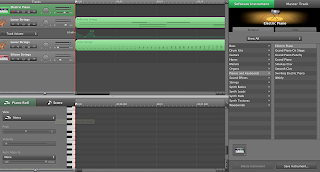
Tuesday, 16 November 2010
Pre-Production Evaluation (Cinematography)
Cinematographer- Josh Murray
In the creation of any film there are many roles which all need to be fulfilled to ensure that the film is planned, shot, edited and completed to the best possible quality. This was no different with our horror opening, although the fact that our group includes just two people meant that we realised we would have to share many jobs between us. However, we both decided on a role which we would focus on throughout the process, and I chose to be the cinematographer.
My role will be a very important one if we are to make a top quality film, and will require me to play a massive part throughout the entire shooting process.
Firstly, I will be responsible for maintaining that each setting is correct, and that all the props are positioned effectively to create the right atmosphere and mise-en-scene for our genre: in the case of 'Home Video', I will have to ensure that generic conventions such as shadows are upheld, and that effective props such as the televisions are working prior to shooting. Our aim is of course to create the best possible film, and a massive aspect of this is continuity. Although this aspect will be examined and adjusted in the editing suite, it is the job of the cinematographer to guarantee that each shot (from different angles and positions) will not reveal differing situations.
Possibly the most prominent role for me in our task will be the actual filming. Our film must be between 4 and 5 minutes in length, and after writing our script, step outline and written storyboard we managed to decide on 78 shots that would be needed. It will be my job to position everything in the scene (the actors, props and lighting) as well as the camera itself, and then shoot the scene; this could mean I just stand there and watch over the action, or use the camera if tracking, panning or zooming is needed. As I wish for our film to look professional, I will take it upon myself to reshoot any shot which looks poor or are not completed in the way that we envisaged.
However, although we have decided on a definite amount of shots, this is going to be flexible, and I believe that we will shoot over 100 shots to create a lot of items to be used by the editor. These decisions will again lie with me, and I will confer with Sam when making changes or additions to shots throughout the film.
The relationship between the cinematographer and the editor is vital, and Sam and I will make sure that we always talk through the shots that I am going to take, as it will be he who has to work with the shots in the editing suite.
An important resource that we have used throughout our planning process has been the various films that relate to our sub-genre of psychological horror. The ones that inspired me most as a cinematographer were 'The Grudge' and 'The Ring', as both use camera angles and mise-en-scene to enhance the tension and fear which is already evident through the setting. Firstly, the use of televisions as a tool for the supernatural in 'The Ring' is something that we are very keen on using, and I have already planned several canted angle shots of the television which will create a sense of confusion in the first and final scene. Furthermore, there is several high angle shots in both films (especially on the stairs) that show the position of weakness and loneliness that the protagonist finds themselves in; this is something I plan to shoot as our female character ascends the stairs cautiously. Finally, the way that the film openings are shot allow the viewer to understand that something 'supernatural' is going on, whilst keeping the narrative restricted, as we are never certain of what is occuring. This is something I will concentrate on in the final scene, when the character begins to feel uncomfortable.
Overall, my role as cinematographer will mean that I must take a constant interest in the entire shooting process; ensuring that the scene is perfect BEFORE the camera begins to roll, at which point I will stand behind the camera and shoot the entire scene. Although it is a lot of work, I feel that the role will be both enjoyable and rewarding, and I can learn a lot about the processes as I go along.
In the creation of any film there are many roles which all need to be fulfilled to ensure that the film is planned, shot, edited and completed to the best possible quality. This was no different with our horror opening, although the fact that our group includes just two people meant that we realised we would have to share many jobs between us. However, we both decided on a role which we would focus on throughout the process, and I chose to be the cinematographer.
My role will be a very important one if we are to make a top quality film, and will require me to play a massive part throughout the entire shooting process.
Firstly, I will be responsible for maintaining that each setting is correct, and that all the props are positioned effectively to create the right atmosphere and mise-en-scene for our genre: in the case of 'Home Video', I will have to ensure that generic conventions such as shadows are upheld, and that effective props such as the televisions are working prior to shooting. Our aim is of course to create the best possible film, and a massive aspect of this is continuity. Although this aspect will be examined and adjusted in the editing suite, it is the job of the cinematographer to guarantee that each shot (from different angles and positions) will not reveal differing situations.
Possibly the most prominent role for me in our task will be the actual filming. Our film must be between 4 and 5 minutes in length, and after writing our script, step outline and written storyboard we managed to decide on 78 shots that would be needed. It will be my job to position everything in the scene (the actors, props and lighting) as well as the camera itself, and then shoot the scene; this could mean I just stand there and watch over the action, or use the camera if tracking, panning or zooming is needed. As I wish for our film to look professional, I will take it upon myself to reshoot any shot which looks poor or are not completed in the way that we envisaged.
However, although we have decided on a definite amount of shots, this is going to be flexible, and I believe that we will shoot over 100 shots to create a lot of items to be used by the editor. These decisions will again lie with me, and I will confer with Sam when making changes or additions to shots throughout the film.
The relationship between the cinematographer and the editor is vital, and Sam and I will make sure that we always talk through the shots that I am going to take, as it will be he who has to work with the shots in the editing suite.
An important resource that we have used throughout our planning process has been the various films that relate to our sub-genre of psychological horror. The ones that inspired me most as a cinematographer were 'The Grudge' and 'The Ring', as both use camera angles and mise-en-scene to enhance the tension and fear which is already evident through the setting. Firstly, the use of televisions as a tool for the supernatural in 'The Ring' is something that we are very keen on using, and I have already planned several canted angle shots of the television which will create a sense of confusion in the first and final scene. Furthermore, there is several high angle shots in both films (especially on the stairs) that show the position of weakness and loneliness that the protagonist finds themselves in; this is something I plan to shoot as our female character ascends the stairs cautiously. Finally, the way that the film openings are shot allow the viewer to understand that something 'supernatural' is going on, whilst keeping the narrative restricted, as we are never certain of what is occuring. This is something I will concentrate on in the final scene, when the character begins to feel uncomfortable.
Overall, my role as cinematographer will mean that I must take a constant interest in the entire shooting process; ensuring that the scene is perfect BEFORE the camera begins to roll, at which point I will stand behind the camera and shoot the entire scene. Although it is a lot of work, I feel that the role will be both enjoyable and rewarding, and I can learn a lot about the processes as I go along.
Friday, 12 November 2010
Sound Step Outline
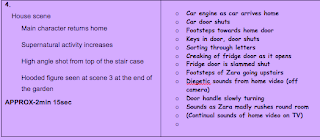
 These sheets link with the previously completed step outline, adding the important element of sound. Using this exercise, we have planned all of the major diegetic and non-diegetic sounds which will be heard in each scene of our film. Almost all of the sounds will be relevant, with very little contrapuntal; this is visible in what we have written.
Pre-Production Evaluation (Editing)
Editor- Sam Van de Schootbrugge
In order to produce the best possible film we needed to designate certain roles within our group. I chose to focus on the editing.
My role as editor is important for an excellent film. I get given the several hours worth of shots and filming, and must decide which of them look best. My job is to deliver good Composition and Continuity throughout the final 5 minute assessed piece so that the film can be scary for all the right reasons. Bad editing can lead to the audience becoming bored, the film not being scary where we want it to be and it could deliver the wrong messages.
I must produce something that is enjoyable to watch and in order to this I must have the idea for what our group wants our film to look like constantly in the forefront of my thoughts. This idea that we have set out to portray comes from several horror films that we have seen and enjoyed in the past. My other group member and I also wanted the film to be a horror which keeps the audience constantly thinking. We didn’t just want to make a ‘slasher’, because we believe that this could become cheesy and is and easy way of making a horror. We believe making a supernatural/paranormal horror would make it enjoyable to film and to edit, and would be the most effective way of scaring our target audience.
Also, as part of my role I will advise the director/cinematographer on shots and shot lengths depending on what I believe will look nicest when edited. I will also need to ask him to take as many shots as possible and at the appropriate length so that I can make the most of the material I receive and will then not have film it again.
The films that inspired us to follow this type of genre are classics such as ‘The Ring’, ‘Poltergeist’, ‘The Grudge’ and ‘Psycho’. For me they were great examples of perfectly edited films and also contain the same sub-genre; psychological horrors. The TV scene in The Ring is edited in such a way that we can really sense that something ‘supernatural’ is going on. Poltergeist also has a very classic scene with the TV in the bedroom. This scene is also edited to shows supernatural things happening. The Grudge has been edited beautifully by putting in lengthy shots to add tension and it slows down the pace to gets viewers on the edge of their seat during the more tense scenes. This example is what I am looking to do in our opening. The more tense shots will be longer in time than the shots where we don’t want to portray as much tension. Just before the end of our opening sequence I will try to increase the pace to add fear and anxiety to the audience (see shots 59-61 on shot list). Shots shown in the graveyard I will try to make long enough to show that the hooded figure is a threat, but I won’t make them too long as it could add unnecessary tension.
My role is largely towards the end of the filming process, but I will still be advising and contributing towards all aspects of the opening sequence.
Wednesday, 10 November 2010
Sound Analysis- Horror Openings


One of the most important conventions of a horror film is the sound. Although it often goes unnoticed, it can be used to build up suspense and tension, as well as being used as a tool to shock the audience. In this exercise, we researched two psychological horror openings that we had already watched and analysed both the diegetic and non-diegetic sound. Some of the things we discovered may well be used in our film (such as the rustling of leaves).
Reccee Sheet


These sheets are used to show that we have
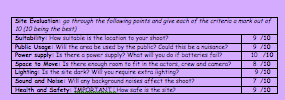 permission for using the location in which we want to film. Also, it allows us assess whether it will be the best place for our shots, as well as looking at health and safety and the ability for us to shoot here.
The photo's are shots of the location that is going to be most used. One is of the TV, where the homevideo is shown, another is of the hallway in which we will have the longest shot to created tension before the final scene. The other one is of the mothers bedroom which will be messy during the filming process
Make Up Design Sheet

This is our make-up design sheet. As you can see we will be usingminimal make-up as there is no blood involved in the making of our film. However, costume is the vital element.

Tuesday, 9 November 2010
Written Storyboard
One of the most time consuming parts of planning is the written storyboard. On this document you write down the shot length, type and style as well as what will be occuring in each single shot for the entire length of film. Although we are fairly certain that some aspects may change, the majority of shots that we have decided upon and written into this storyboard will indeed be in the film.
The TOTAL TIME of all 61 shots together is 4 mins & 12 secs.


Home Video Script
This is the script we are using for our assessed film piece. It contains 4 and a half minutes worth of script all of which is relevant to the film.

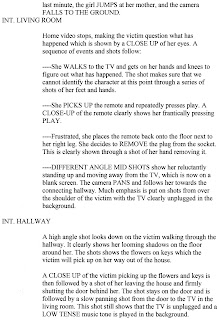
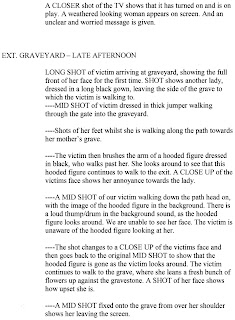
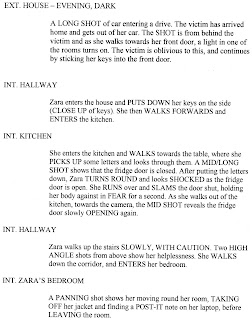
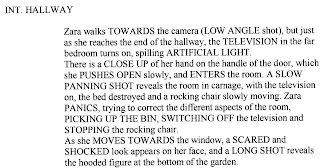
(NB. A change has been made to the INT. LIVING ROOM scene: where 'strange angles' has been written, we will be shooting the shots at a canted angle.)
Production Schedule and Information


These sheets give us proof of actors details and confirmation that they can perform, as well as a checklist for equipment (such as lighting and props) and information on the locations that we will be using for filming.
Subscribe to:
Posts (Atom)