Wednesday, 1 December 2010


These images are taken from our homevideo scene. This is a children play area, where we shot zara as a little girl playing with her deceased mum.
Production evaluation

Production evaluation

As role of editor it was vital for me to play a significant part in the shooting of our horror film. This is because it was important for me to see which shots worked very well on the day and which did not. At the start of each scene I was able to say on camera if the shot before was relevant and what I did or didn’t like about it, making it a lot easier when it comes down to the final editing.
Also, I liaised with the director, cinematographer and the sound designer to tell them which shots I thought would work for good continuity and composition. I asked the cinematographer if he could shoot the scenes in long parts so that when it comes to the editing I can make shots shorter where needed to make good continuity. If the shots weren’t long enough, it would have made it a nightmare. I would have had to have put several short shots together to make a longer scene. The camera could’ve been in different places and the composition may not be the same throughout if it was shot in smaller shots. I also gave advice to the director as to where the camera had to be put in order to maintain good continuity throughout the final film. And, because I already have an idea as to what the final film should look like, due to the fact that I have to edit it, I advised the director about certain shots which I thought would add the most horror affect to the final film, and would show the characteristics of a psychological horror.
To make the final sequence look perfect it was vital for me to make sure that the pace and length of each shot was adequate and fitted the scene. A shot that looked out of place, or which was shot too slow or too long had to be removed or noted down whether the shot was good or not. If the run up to our final shot was too fast, it may not have delivered the right amount of tension, because a slow shot creates fear and a sense of unknown for the audience. Also, during the kitchen scene, if the victim shut the fridge door slowly, it wouldn’t have had an as big effect as if she closed it fast. When the pace of a shot is fast, it gets the audience panicking and increases the nerves, furthermore, it foreshadows that something is going to happen towards the end of the sequence.
Finally, I made it clear to the director/cinematographer that I would like the shots to be shot in order according to the storyboard. This makes it easier to follow when it comes to editing the shots. A disorganized sequence of shots can take lots more time to edit and could cause confusion about which shot goes where.
Sam Van de Schootbrugge- Incentive

Friday, 19 November 2010

Scheduling

With the planning completed, our task now turns to shooting our horror film. In the next two or three weeks, we want to have ALL filming done to allow us time to edit and add sound etc. This post shows our schedule for filming, and we will try to maintain this schedule to ensure we do not leave ourselves too much work to do in a short space of time.

Home Video: 20th/21st November

Interior House Shots: 23rd & 24th November

Exterior Shots (Graveyard): 27th November

ALL SHOT: 4TH DECEMBER

Wednesday, 17 November 2010

Garageband First Attempt

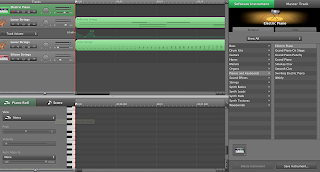
The most thrilling horror films all contain a chilling and memorable soundtrack, and this is something which we want to include in 'Home Video'. Although much of the film will be silent or eerily quiet (to create tension), there are certain scenes in which some non-diegetic music will add to the effect. The below screenshot shows how we have used the software 'Garageband' to begin creating relevant music. We have used both high and low pitches on top of each other to fulfill our desire to create tension throughout.

Tuesday, 16 November 2010

Pre-Production Evaluation (Cinematography)

Cinematographer- Josh Murray

In the creation of any film there are many roles which all need to be fulfilled to ensure that the film is planned, shot, edited and completed to the best possible quality. This was no different with our horror opening, although the fact that our group includes just two people meant that we realised we would have to share many jobs between us. However, we both decided on a role which we would focus on throughout the process, and I chose to be the cinematographer.

My role will be a very important one if we are to make a top quality film, and will require me to play a massive part throughout the entire shooting process.
Firstly, I will be responsible for maintaining that each setting is correct, and that all the props are positioned effectively to create the right atmosphere and mise-en-scene for our genre: in the case of 'Home Video', I will have to ensure that generic conventions such as shadows are upheld, and that effective props such as the televisions are working prior to shooting. Our aim is of course to create the best possible film, and a massive aspect of this is continuity. Although this aspect will be examined and adjusted in the editing suite, it is the job of the cinematographer to guarantee that each shot (from different angles and positions) will not reveal differing situations.

Possibly the most prominent role for me in our task will be the actual filming. Our film must be between 4 and 5 minutes in length, and after writing our script, step outline and written storyboard we managed to decide on 78 shots that would be needed. It will be my job to position everything in the scene (the actors, props and lighting) as well as the camera itself, and then shoot the scene; this could mean I just stand there and watch over the action, or use the camera if tracking, panning or zooming is needed. As I wish for our film to look professional, I will take it upon myself to reshoot any shot which looks poor or are not completed in the way that we envisaged.
However, although we have decided on a definite amount of shots, this is going to be flexible, and I believe that we will shoot over 100 shots to create a lot of items to be used by the editor. These decisions will again lie with me, and I will confer with Sam when making changes or additions to shots throughout the film.
The relationship between the cinematographer and the editor is vital, and Sam and I will make sure that we always talk through the shots that I am going to take, as it will be he who has to work with the shots in the editing suite.

An important resource that we have used throughout our planning process has been the various films that relate to our sub-genre of psychological horror. The ones that inspired me most as a cinematographer were 'The Grudge' and 'The Ring', as both use camera angles and mise-en-scene to enhance the tension and fear which is already evident through the setting. Firstly, the use of televisions as a tool for the supernatural in 'The Ring' is something that we are very keen on using, and I have already planned several canted angle shots of the television which will create a sense of confusion in the first and final scene. Furthermore, there is several high angle shots in both films (especially on the stairs) that show the position of weakness and loneliness that the protagonist finds themselves in; this is something I plan to shoot as our female character ascends the stairs cautiously. Finally, the way that the film openings are shot allow the viewer to understand that something 'supernatural' is going on, whilst keeping the narrative restricted, as we are never certain of what is occuring. This is something I will concentrate on in the final scene, when the character begins to feel uncomfortable.

Overall, my role as cinematographer will mean that I must take a constant interest in the entire shooting process; ensuring that the scene is perfect BEFORE the camera begins to roll, at which point I will stand behind the camera and shoot the entire scene. Although it is a lot of work, I feel that the role will be both enjoyable and rewarding, and I can learn a lot about the processes as I go along.

Friday, 12 November 2010

Sound Step Outline

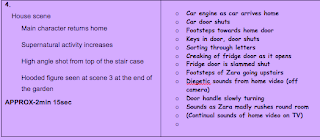
These sheets link with the previously completed step outline, adding the important element of sound. Using this exercise, we have planned all of the major diegetic and non-diegetic sounds which will be heard in each scene of our film. Almost all of the sounds will be relevant, with very little contrapuntal; this is visible in what we have written.

Pre-Production Evaluation (Editing)

Editor- Sam Van de Schootbrugge

In order to produce the best possible film we needed to designate certain roles within our group. I chose to focus on the editing.

My role as editor is important for an excellent film. I get given the several hours worth of shots and filming, and must decide which of them look best. My job is to deliver good Composition and Continuity throughout the final 5 minute assessed piece so that the film can be scary for all the right reasons. Bad editing can lead to the audience becoming bored, the film not being scary where we want it to be and it could deliver the wrong messages.

I must produce something that is enjoyable to watch and in order to this I must have the idea for what our group wants our film to look like constantly in the forefront of my thoughts. This idea that we have set out to portray comes from several horror films that we have seen and enjoyed in the past. My other group member and I also wanted the film to be a horror which keeps the audience constantly thinking. We didn’t just want to make a ‘slasher’, because we believe that this could become cheesy and is and easy way of making a horror. We believe making a supernatural/paranormal horror would make it enjoyable to film and to edit, and would be the most effective way of scaring our target audience.

Also, as part of my role I will advise the director/cinematographer on shots and shot lengths depending on what I believe will look nicest when edited. I will also need to ask him to take as many shots as possible and at the appropriate length so that I can make the most of the material I receive and will then not have film it again.

The films that inspired us to follow this type of genre are classics such as ‘The Ring’, ‘Poltergeist’, ‘The Grudge’ and ‘Psycho’. For me they were great examples of perfectly edited films and also contain the same sub-genre; psychological horrors. The TV scene in The Ring is edited in such a way that we can really sense that something ‘supernatural’ is going on. Poltergeist also has a very classic scene with the TV in the bedroom. This scene is also edited to shows supernatural things happening. The Grudge has been edited beautifully by putting in lengthy shots to add tension and it slows down the pace to gets viewers on the edge of their seat during the more tense scenes. This example is what I am looking to do in our opening. The more tense shots will be longer in time than the shots where we don’t want to portray as much tension. Just before the end of our opening sequence I will try to increase the pace to add fear and anxiety to the audience (see shots 59-61 on shot list). Shots shown in the graveyard I will try to make long enough to show that the hooded figure is a threat, but I won’t make them too long as it could add unnecessary tension.

My role is largely towards the end of the filming process, but I will still be advising and contributing towards all aspects of the opening sequence.